Category: Uncategorized

  • SpaceX Rocket Launches Crew Of Four To International Space Station

    SpaceX Rocket Launches Crew Of Four To International Space Station

    SpaceX launched a crew of four astronauts to the International Space Station early on Thursday, the company’s sixth operational mission for NASA’s Commercial Crew program, after a technical issue had prevented a launch earlier in the week.

    SpaceX’s Falcon rocket launched the four astronauts onboard its reusable Dragon 2 spacecraft from the Kennedy Space Center around 30 minutes past midnight E.T.

    The Crew-6 mission is carrying two NASA astronauts, Stephen Bowen and Warren Hoburg, Russian cosmonaut Andrei Fedyaev and Emirati astronaut Sultan al-Neyadi.

    Al-Neyadi is only the second person from the UAE to take part in a space mission after Hazza Al Mansouri and he is also the first Arab astronaut set for an extended stay onboard the ISS.

    Thursday’s launch is the fourth spaceflight for the reusable Dragon 2 spacecraft known as Endeavour.

    The four astronauts will take over from the members of the Crew-5 mission who are currently onboard the ISS and are set to fly back to Earth later this month.

    Al-Neyadi, who is set to stay on board the ISS for several months has said he may try to fast “on some days” during the Muslim holy month of Ramadan if the schedule allows. The Emirati astronaut, however, noted all travelers like him are exempt from the obligation.

    The crewed launch was originally scheduled to take place early on Monday but had to be called off just minutes before liftoff due to an issue with the Falcon 9 rocket’s ignition fluid. Aside from the four members of the Crew-5 mission the ISS is currently also hosting two Russian cosmonauts and one American astronaut whose stay has been extended due to a fault in the Russian-made Soyuz capsule that was set to fly them back. A replacement Soyuz craft arrived at the space station late last week.

    SpaceX launches Crew-6 astronaut mission to space station for NASA (Space)

    [Read More…]

  • Stephen Curry Is Showing No Signs Of Slowing Down In Year 14

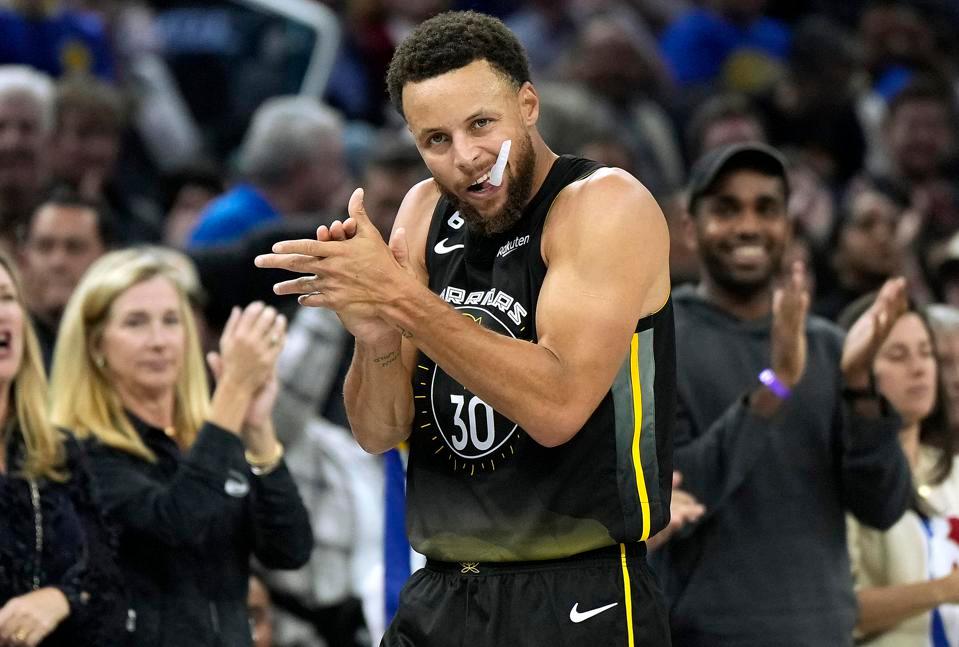
    Stephen Curry Is Showing No Signs Of Slowing Down In Year 14

    Stephen Curry might be a Warrior for life, but he’s more of a wizard than anything. Throughout the 76 years of NBA action, there has never been a player that can enrapture an entire audience with their on-ball skills while simultaneously putting a defense in peril with off-ball motion.

    The devastating crossovers, swift change of direction, and parking lot shooting range will always be his superpowers. With the nature of how basketball is viewed – for every 10 fans, eight are probably focused on the ball-handler – the recognition of Curry’s talent and greatness will always point to those tangible attributes. They are easily identifiable.

    When the ball touches his hands, everyone in attendance expects to be left speechless.

    Usually, they are. Or they erupt in jubilation as he drills a 35-footer, signaling to the opponent it’s time for bed. Over the last decade, his off-the-dribble mastery and scoring creativity have revolutionized the sport. Now, the three-point frequency (proportion of shots generated from beyond the arc) is approximately 39% league-wide. In 2013-14, before the Warriors jumpstarted their dynasty, it was below 26% with the most perimeter-happy teams reaching 33%.

    Yet, Curry’s legacy and generational impact should go beyond that.

    His movement away from the ball is just as mesmerizing as the pull-up shooting. It’s just as lethal and requires the same amount of craft. You don’t just wake up one morning in the middle of the season and decide to buy into the off-ball strategies. There is a sense of selflessness required just to become good at it. To make it part of your identity, there is a heavy dose of commitment and big-picture mindset a player must possess.

    Curry has made it cool for guards to set screens for one another. He and Nikola Jokić are the two primary reasons we’re seeing more inverted pick-and-rolls – with big men realizing they can benefit from a guard creating confusion, or enticing a switch they know the defense doesn’t want to concede.

    Before Curry’s rise to Bay Area legend status, when did it ever seem beneficial for a player to sprint away from the ball, knowing they weren’t going to touch it on that possession? Curry could teach two masterclasses once he retires: How to manipulate a defense while receiving a ball-screen, and how to be a perfect decoy for your teammates. The list of players to have both of those traits is non-existent – because a list implies there’s more than one.

    Yet, for all his greatness, Curry is facing a laborious task. This year is testing the strength and durability of his shoulders, carrying so much of the weight offensively for a Warriors group that can’t put together a win streak.

    Curry has started the season on fire from practically everywhere. The Warriors’ starters have played 151 minutes together, the fifth-most of any lineup in the league. They have outscored teams by 24 points per 100 possessions, the equivalent of any ‘Death Lineup’ from past iterations of the team. Yet, Golden State is 6-8 and can’t win a game on the road.

    If it weren’t for Curry’s heroics, though, it would be much uglier.

    In his first 13 games coming off a dazzling Finals performance, Curry is averaging 31.5 points, 6.6 rebounds, and 6.4 assists with a 69.2% true shooting mark, which still sounds inconceivable even by his standards.

    Per Cleaning the Glass, the Warriors’ offense is 18 points per 100 possessions better when he’s on the floor versus when he sits — it would be the second-highest differential of his career, behind only the 2016-17 season (+18.4). If you remember back to that particular year, although Kevin Durant was helping lead bench units, there was still a month late in the schedule where Curry had to tap into his unanimous MVP magic to keep the Dubs winning once Durant hurt his knee.

    For the sake of comparison, let’s look at how Curry started two of his most memorable campaigns. In 2020-21, he finished third in MVP voting behind Joel Embiid and Nikola Jokic. It was the last time he got that close to winning the award since 2015-16, which is also pictured below. His 2016 production should honestly be carved on a plaque and sent to the Naismith Basketball Hall of Fame. It should be remembered as the best regular season this sport has witnessed:

    It’s eerie how similar Curry’s recent scoring stretch is to the October-November 2015 start. The efficiency is identical, albeit on less volume because 27-year-old Steph was at the peak of his powers. Scoring 1.56 points per shot this season, only marginally below his 2015 mark, might be the most impressive part considering the free throw attempts aren’t as high.

    Seven years ago when he was torturing bigs in drop coverage and setting a new trend, Curry nailed 68 threes in his first 13 games. That put him on pace for 413 triples if he appeared in 79 games (which he ultimately did, so we’ll use that number). He finished with 402. So, while he technically slowed down by a hair, his pace was steady throughout the season.

    Having already rested one game and factoring in his recent history (27 missed games of the last two years), let’s assume he plays roughly 68 games this season. Curry’s pace would be 340 threes, which would be his third-most for a single year. It would also give him seven appearances on the top 10 of that list. Seven!

    They can be generated from guard-to-guard ball-screens, pick-and-rolls starting from the logo, or quick handoffs where he’s banking on the defense resting for just a second. The result will be the same:

    For good reason, the first thing entering a viewer’s mind when Curry steps on the floor is the unequaled shooting touch. After all, he captivates the audience with a unique form of shot creation and proper efficiency to warrant the audacious attempts.

    Aside from the shotmaking, what separates Curry from other guards his age is the finishing ability. It’s a facet of his game most of us figured would take a step back, simply due to the natural regression of speed and quickness. However, for every ounce of burst that he’s lost, he’s made up for it with strength and veteran IQ.

    After 13 games, Curry is 35-of-43 at the rim, converting 81.4% of his attempts. Despite having quality spacing in some lineups, these are not all uncontested looks in the paint. Playing a large chunk of his minutes alongside Draymond Green and Kevon Looney, he rarely beats the first line of defense without having a bigger body waiting for him around the basket.

    With him, it doesn’t matter who slides over to help. He finishes with such grace, right or left-handed, taking off with either foot:

    If you hard hedge, he’s splitting the two defenders and getting into the paint. If you switch, he’s calmly taking the opposing big man off the dribble and compromising the defense.

    Not matched up properly in transition? He’s exploiting it within seconds and not letting you reset. Bringing your big man up at the level of the screen? He’s still quicker than he looks, so you better have backline help in the paint.

    The manner in which Curry dissects a defensive coverage, making a split-second decision to either attack or give his team a 4-on-3 advantage once he sees a trap, is rivaled only by Dončić. Every year, regardless if Golden State is coming off a championship run, he returns smarter and more seasoned in the halfcourt.

    During the last two offseasons, Curry worked extensively on his strength training. He wanted to ensure he’s tougher to guard despite being bumped around by defenders that get away with grabbing and holding him. But he also knew improving his upper-body power would make him harder to move defensively (it worked, as Curry had the best defensive season of his career last year en route to a title).

    Taking a look at his paint numbers this year, we could see the most efficient season he’s had as a driver and finisher:

    Along with leading the NBA in points per shot, Curry is also number one in Estimated Plus-Minus (EPM), an advanced metric from Dunks & Threes that captures a player’s impact on both ends of the floor. His +8.7 EPM is slightly above Dončić (+8.1), and comfortably ahead of Kevin Durant (+6.9), Shai Gilgeous-Alexander (+6.3), and Jayson Tatum (+6.2) to round out the top five.

    In BPM, Basketball-Reference’s impact metric with a similar goal, Curry is second to Dončić.

    Any way you slice it, those two guards have been the NBA’s best performers during this opening month. Coincidentally, they also face the same dilemma. Without them providing huge scoring outbursts or controlling the terms of each possession, their teams are in trouble.

    We already know about the Mavericks’ roster issues and how unhealthy it is for a championship contender to be that isolation-heavy. While it doesn’t feel as if the Warriors are quite as reliant on Curry (thanks to their free-flowing motion offense), the results have often mirrored it. Golden State is 1-4 when Curry scores fewer than 30 points or doesn’t play. In their five other wins, he’s averaged 40.4 points with some late-game heroics to help overcome fourth quarter deficits to Cleveland and Sacramento.

    If this were 2016, nobody would think twice about asking Curry to dig this deep every night and claw them to victory. But given the circumstances, this is gearing up to be an unprecedented season for the four-time champ.

    Curry will turn 35 in less than four months. When Magic Johnson turned 35, he had already been retired for four years. At the same age, Isiah Thomas was in year three of retirement. Steve Nash was in the final year of his Suns tenure, and Jason Kidd had already transitioned into a role player for the Mavericks. John Stockton may have been competing in the NBA Finals during his 14th season, but the individual production took a hit in his mid-thirties.

    None of those players carried a fraction of the scoring burden Curry has to endure at this stage.

    The only two point guards to be considered elite at 35 are Curry and 2020 Chris Paul, and we know how vastly different their styles are on the court. Curry will be the only that has maintained a sky-high usage. In some ways, it’s the guard equivalent of what LeBron James had to do in 2020, also at 35, dominating throughout the playoffs and seemingly getting better with age.

    Except, you know, there was a prime co-star next to him named Anthony Davis, who had the best stretch of his career to help the Lakers capture the title.

    It doesn’t appear Steph is going to have that type of help during his age-35 season. Unless, of course, the Warriors package their young players and future draft picks to obtain more playoff-ready talent. It’s not going to come in the form of another All-Star – at least I don’t think. But much like last season, with Otto Porter Jr., Gary Payton II, and even Nemanja Bjelica, it would be by committee.

    The Warriors’ defensive struggles and youth movement are largely to blame for their early season woes. Rarely will you find this team ranking in the bottom 10 of halfcourt defensive rating over the course of a month. But that becomes the reality when half of the bench rotation has changed and you’re relying on inexperienced players to be in the right spots defensively.

    There has to be room for trial and error. Golden State having a target on its back this year — much like every defending champion — doesn’t help James Wiseman, Moses Moody, or Jonathan Kuminga. A few blown switches, late rotations, or miscommunications on defense were bound to happen. That’s part of the NBA growing pains. But in a loaded West, for a team looking to secure homecourt advantage in at least the first round, the Warriors don’t have time to mold young talent. If they prioritize those hand-holding moments, Curry’s title window will soon be closed.

    In the same way their defensive cohesion falls apart when the starters rest, the offensive errors pile up when their leader gets a breather. With the reigning Finals MVP on the court, Golden State only commits a turnover on 13.5% of their possessions. For context, that would be among the five lowest turnover marks in the league. When Curry is off the floor, the Dubs cough it up on 20.1% of their possessions — a rate that would be dead last in the NBA by a country mile.

    Needless to say, life falls apart for Golden State unless Curry and Green are dictating everything. It probably isn’t a recipe for success throughout a long 82-game season, considering the injury bug hasn’t affected them yet and they still aren’t above .500.

    Yes, it’s true there isn’t much pressure on Curry or the Warriors this year. This should be a feel-good season after they reclaimed their trophy and laughed at every doubter. They don’t have to prove anything to anyone after what they accomplished.

    However, it’s important to understand one thing. Mount Rushmore-level talents don’t come around all the time. Any franchise would be lucky to land someone of Stephen Curry’s caliber – much less have him committed and signed through 2026, a full 17 years after being drafted.

    Anything it takes to extend Curry’s window and chase more deep playoff runs, they shouldn’t hesitate.

    [Read More…]

  • Katie Holmes Makes the Crop Top Wearable

    Katie Holmes Makes the Crop Top Wearable

    Katie Holmes majors in everywoman dressing. The Dawson’s Creek actor is often pictured running errands in New York wearing relaxed jeans and easy dresses. When she steps out after dark, the actor stays true to her low-fi uniform, relying on just a few styling tricks to amp up her signature girl-next-door aesthetic.

    Heading out for dinner at Balthazar in New York to celebrate a Mango store opening, Katie proved her skill at elevated minimalist dressing yet again by whipping out her tailored separates. She eschewed her faithful wide-leg jeans and cashmere knits for a pair of high-waisted black trousers. In a bold move that nobody saw coming, the actor opted for a white cropped top and slipped on a pair of platform flip-flops.

    As proved by Katie, minimalist dressing can pack a punch with just a little heavy lifting. Follow suit this spring and consider loading up on a few navel-skimming crop tops to maximize your wardrobe. 

    [Read More…]

  • Can web filtering really harm the kids?

    Can web filtering really harm the kids?

    Web filtering is undoubtedly an essential when it comes to school cybersecurity. However, when the service is not set up correctly or a number of blocked categories is way too high, it starts to annoy both staff, and kids. Let’s see how to use web filtering to stay safe out there on the internet and make full use out of it.

    Starting with the basics, it makes sense to remind ourselves what CIPA is. The Children’s Internet Protection Act, signed into law in 2000, is a document that regulates the exposure of inappropriate content to children. To be precise, the content that shall be filtered or blocked is divided into 3 groups: obscenity, child pornography & content harmful to minors. To receive funding, an educational institution must follow the guidelines of the act. The easiest way to comply with it is to purchase a web filtering solution. Needless to say, K-12 schools must be CIPA compliant to use E-Rate discounts, but those schools and libraries that do not receive the fundings do not have this obligation.

    Web filtering solutions work on a DNS level, blocking all unwanted websites: both malicious ones with viruses lurking around, and all kinds of explicit content. In a nutshell, the DNS system matches IP addresses and the names of the websites working as a phonebook of the Internet. DNS filtering, however, also categorizes the website to see if it belongs to any restricted groups. This part is usually customizable: you choose which type of sites you want gone (or vice versa – you create an Allow list, which contains only the resources you want your students, staff & guests to see, and everything else is blocked), and leave it be.

    Now, here’s the main question – how can web filtering possibly be of harm for the kids? It protects them from things their minds are not ready for, it saves them from being hacked. However, sometimes blocking way too much content might limit the kids’ learning process. CIPA clearly states that content “harmful to minors” must be blocked, which sometimes is read as “block everything” by adults. Mary Beth Hertz, the art/tech teacher and technology coordinator at Science Leadership Academy at Beeber, a public high school in West Philadelphia, shared an opinion on blocking content for kids: “We limit their opportunities to succeed, explore their passions, and discover their strengths and talents.”

    Valerie Sauver is a marketing specialist at SafeDNS & a cybersecurity enthusiast.

    [Read More…]

  • VHS Learning’s New Flexible Courses Expand Student Options for Online Course Enrollment

    VHS Learning’s New Flexible Courses Expand Student Options for Online Course Enrollment

    Boston – May 12, 2022 – Scheduling flexibility is frequently cited by students and teachers as a major benefit of working with VHS Learning’s asynchronous online courses. Starting in August, students will be able to take advantage of an even more flexibly paced course format.

    The new Flexible course model will be available for 16 courses beginning in the 2022-2023 academic year:

    Each Flexible course is self-paced, and teacher led. Courses begin on the first of every month from August through February (August through December for AP® courses). The courses will end at the completion of the school year, so later enrollees will progress through course material at a faster pace.

    “We specifically designed these courses for students who wish to have more flexibility in their academic schedule,” said Carol DeFuria, President & CEO of VHS Learning. “Some students would like to enroll in a course after the beginning of the traditional fall semester start. Now, whether they’re working toward academic goals, career goals, or they simply want to explore a new interest, our Flexible courses give them more choice regarding when they embark on learning.”

    “As in all our courses, students taking Flexible courses will receive significant teacher support. VHS Learning teachers interact with students in asynchronous discussions, host weekly office hours, and invite students to monthly one-on-one progress meetings,” DeFuria continued. “This new course model is part of our mission to empower schools with the industry’s best teacher-led online learning programs and provide students with an expansive choice of courses that prepare them for college, careers, and beyond.”

    VHS Learning has a 25-year reputation for educational quality, including rigorous professional development for the certified teachers who provide course instruction. All VHS Learning teachers complete graduate-level Online Teaching Methodologies (OTM) training to learn best practices for online teaching and learning, and 81% of VHS Learning teachers possess a master’s degree or higher. The nonprofit’s vision is to prepare students for college, careers, and life and well-trained teachers are an essential part of the equation.

    About VHS Learning

    VHS Learning is a nonprofit organization with over 25 years of experience providing world-class online programs to students and schools everywhere. Offering more than 300 unique online courses for high school credit, including 25 AP® courses, credit recovery, and enrichment courses, VHS Learning is accredited by Middle States Association Commission on Elementary and Secondary Schools (MSA-CESS), Accrediting Commission for Schools, Western Association of Schools and Colleges (ACS WASC), and Cognia. Courses are approved for initial eligibility by NCAA. For more information about VHS Learning please visit https://www.vhslearning.org/ and follow on Twitter at @VHSLearning.

    [Read More…]

  • 7 strategies to counter student learning loss

    7 strategies to counter student learning loss

    Until very recently, learning loss was a matter of concern mainly because of long summer holidays. Students’ socioeconomic situations played a role in those concerns but, mostly, making up for the knowledge and skills lost over school breaks involved returning learners to their school routines.

    And, of course, revising the last few weeks of last semester’s curriculum before moving on to new material.

    The coronavirus pandemic has redefined what learning loss means. Generally speaking, nobody was prepared for the sudden and dramatic upending of life as they knew it. Some adapted quickly, while others struggle with the mental and physical impacts of COVID to this day.

    Education systems around the world, long holding to traditional teaching templates, found they had neither the equipment nor the training to fall into remote teaching schemes. For most schools, there were no plans for such a contingency.

    For all the suddenness and severity of the situation, schools, teachers, and students met the challenge head-on, adapting as best they could.

    But this infernal virus is not yet done with us. Not only do we have to overcome the learning loss this crisis caused, but we must also contend with possible future instances of missed lessons and school closures.

    Here are seven ways to counter student learning loss.

    1. Frame the issue appropriately. Educators know that they have to make up for lost time; those days and weeks spent out of the classroom knocked entire syllabi off course. The trouble is, teachers can’t just teach most of the course and hope their students learn enough to come out fine in future classes. Catch-up work is necessary but calling it that puts undue pressure on the students. Indeed, it may cause them to feel as though they’ve been laggards rather than afflicted by the same catastrophe that teachers labored under. Revision would be a suitable alternative, or recapping past lessons.

    Sophia Birk is a former English teacher who advocates for innovation in teaching and learning. Her passions include travel, cycling and cultural studies.

    [Read More…]

  • Newsom reaffirms commitment to annual increases for UC, CSU; imposes annual progress reports

    Newsom reaffirms commitment to annual increases for UC, CSU; imposes annual progress reports

    Calling the investments a “game-changer” for California’s public universities, Gov. Gavin Newsom on Friday reaffirmed his pledge to give annual budget increases of 5% to the University of California and California State University systems over the next five years. In exchange, the systems will be expected to make progress and report annually on goals including improved graduation rates, growing enrollment, making college more affordable and preparing more students for high-demand careers.

    Newsom originally proposed those funding agreements in his January budget proposal, dubbing them “multi-year compacts,” and revealed additional details Friday as part of his May budget revision. He also finalized what he is calling a “multi-year roadmap” with the state’s system of 116 community colleges. The community college system is expected to make progress toward similar goals as UC and CSU, though Newsom didn’t tie specific funding increases to progress on those goals since the community colleges receive base funding via Proposition 98.

    In a move described by officials as unprecedented, the governor is also expecting UC, CSU and the community college system to submit annual reports detailing their progress on each of the goals by Aug. 30 for the community colleges and Nov. 30 for the universities, beginning in 2023, to Newsom and the Legislature. Those progress reports mark the first time the systems will have to report to state lawmakers on those specific metrics, according to Newsom administration officials.

    Absent from Newsom’s higher education proposals on Friday was funding to reform the Cal Grant program, the main system for awarding financial aid. Key lawmakers and other advocates for financial aid reform had hoped Newsom would include funding for AB 1746, legislation that would make about 150,000 students newly eligible for financial aid while also simplifying what critics say is an overly complex financial aid program.

    Reactions to the five-year compacts were mixed. Cal State interim Chancellor Jolene Koester said it was disappointing to see the system’s 2022-23 base funding in the May revision remain the same as the January proposal. CSU would receive an additional $211 million in base funding in 2022-23 over its 2021-22 funding, while UC would get about $200.5 million more.

    “With many economic challenges such as inflation impacting every dollar earned by our talented and dedicated faculty and staff, it is imperative that we receive additional funding to better support them and their families by providing appropriate compensation while they work to fulfill the university mission,” Koester said.

    Koester said the CSU system will “intensify efforts” to make sure legislators are aware of the university’s needs.

    Michael Drake, president of the 10-campus UC system, said the promise of annual budget increases “will allow the University of California to make important investments that will expand access to the University for more California undergraduates.”

    In remarks Friday morning about the budget, Newsom said the promise of 5% funding increases would help UC and CSU plan for the future, unlike in the past when they haven’t been guaranteed any specific amount of funding from year to year.

    “We think this will be a game-changer,” Newsom said.

    What’s unclear is whether the systems could lose funding if they fail to make progress on key goals. So far, the only enforcement mechanism unveiled by Newsom is the annual reports that each system will need to provide.

    Cal State

    In the agreement between the Newsom administration and the 23-campus CSU system, the campuses will add 14,000 more undergraduate students over four years through the 2026-27 academic year. That’s equivalent to annual enrollment growth of 1%. The system enrolled 477,446 students in fall 2021.

    At least 12 CSU campuses have to make progress to maintaining a six-year graduation rate that is above 58%. The system also agreed to increase the four-year, freshman graduation rate to 40% by 2025. The agreement is in line with CSU’s Graduation Initiative 2025, which also aims to improve the four-year rate to 40% and the six-year graduation rate to 70% for first-time students.

    In 2021, the four-year, first-time graduation rate was 33% and the six-year rate was 63%.

    CSU also agreed to eliminate equity gaps in graduation between low-income freshmen and transfer students and their higher-income peers, as well as gaps between underrepresented minorities, including Black and Latino students and their white peers, by 2025.

    The university system agreed it would also lower the costs of textbooks and other instructional material by 50% to save $150 million a year for students. CSU also agreed to increase online courses by 15% so every student who wants to take an online course will be able to do so.

    The May revision also includes one-time funding to some CSU campuses, including $80 million for a new science, technology, engineering and math facility for the San Diego State University Imperial Valley campus and $67.5 million to CSU Fullerton’s engineering and computer science innovation hub.

    “We are dealing with the workforce in a way that I am really excited about by working with San Diego State University,” Newsom said. The campus will build a new 65,000-square-foot site that will house new nursing programs, and expand public and environmental health programs.

    Newsom also proposed $100 million in one-time funding to support deferred maintenance across the system’s campuses and energy efficiency projects and $81 million in ongoing dollars for increasing undergraduate enrollment by 9,434 in the 2022-23 academic year.

    University of California

    As part of its five-year compact, UC will be expected to increase undergraduate enrollment by 1% each year following 2022-23 — for a total of 8,000 students over the final four years of the compact. In fall 2021, UC enrolled 230,529 undergraduates. Lawmakers and Newsom are pushing UC to enroll an additional 7,000 students in fall 2022, though the system has so far balked at that suggestion.

    UC will also strive as part of the compact to increase its four-year graduation rate to 76% and its two-year transfer graduation rate to 70%. Currently, 72.6% of incoming freshmen earn a degree within four years while 62.8% of transfers get their degree within two years. Like CSU, UC will also be expected to eliminate equity gaps between its overall graduation rates and graduation rates among low-income and racially and ethnically underrepresented students.

    Other goals for UC include offering 60% of undergraduates the path to a debt-free degree by 2026 and increasing the number of students who get a degree in high-demand areas such as STEM fields by 25%. For incoming California residents in 2022-23, tuition at UC will cost $13,104, and that number will increase for each incoming class over at least the next five years. Many students get their tuition fully covered through the state’s generous financial aid programs but often take on debt to pay for housing and other living expenses, which are especially pricey in California.

    In addition to the annual base budget increases that will be coming to UC, Newsom also proposed a number of one-time funding initiatives for the 10-campus system. They include $185 million for climate research across the system and $300 million for a new Institute for Immunology and Immunotherapy at UCLA.

    California Community Colleges

    Newsom’s proposals for California’s 116 community colleges were praised Friday as “historic” by Eloy Ortiz Oakley, the systemwide chancellor for the colleges. The budget includes $375 million above what Newsom proposed in January to increase the base of the Student Centered Funding Formula, the formula that determines how the colleges are funded.

    In one-time funding, the system would get $750 million that will be allocated to districts as block grants that they can use to address pandemic-related issues or reduce long-term obligations and $1.5 billion for deferred maintenance and energy projects. The colleges would also get one-time funds for initiatives including student retention and enrollment, the implementation of common course numbering and technology upgrades.

    Newsom’s budget would also support community college part-time faculty, also known as adjuncts, with an increase of $200 million in annually recurring dollars to expand their health care coverage.

    “The Governor’s revised budget proposal provides unprecedented levels of support for California community colleges, strengthening our ability to advance educational equity and economic mobility for students and their families,” Oakley said in a statement.

    Oakley also praised the five-year roadmap that Newsom proposed, saying it sets a “bold shared vision.” The goals outlined in the roadmap for the community college system include increasing the number of students earning degrees, certificates or job skills by 20% by 2026; decreasing the average number of units taken by students earning associate degrees; and increasing the number of students who transfer to UC or CSU.

    Cal Grants

    Student leaders and college access advocates expressed disappointment Friday that Newsom’s budget proposal doesn’t include funding required to implement AB 1746.

    The bill would make about 109,000 additional community college students eligible for financial aid by eliminating GPA requirements and guaranteeing the awards to students with a household income low enough to make them eligible for a federal Pell Grant. About 40,000 students attending four-year universities would also become newly eligible for awards.

    The bill would also simplify Cal Grants by consolidating the program into just two awards, one for community college students and one for students attending a four-year university.

    “Today’s college students need affordable access to higher education pathways, especially as our student communities grow and our state continues to weather the workforce challenges brought on by the pandemic,” the Fix Financial Aid Coalition said in a statement voicing displeasure that funding for AB 1746 wasn’t included. That coalition includes the statewide student governments for each of California’s three public college systems as well as the California Student Aid Commission and college access groups such as the Campaign for College Opportunity.

    A spokesperson for Newsom’s Department of Finance said that while there could be negotiations with the Legislature on Cal Grant reform this summer, the cost of AB 1746 runs counter to the administration’s goal of being “fiscally prudent.” Implementing the legislation would cost about $315 million in its first year and about $375 million in subsequent years.

    The spokesperson said the administration focused on funding one-time projects with its budget proposal rather than initiatives that would require annual spending. Supporters of Cal Grant reform, though, have said California should be able to afford AB 1746’s price tag given the state’s budget surplus.

    EdSource reporter Thomas Peele contributed to this story.

    To get more reports like this one, click here to sign up for EdSource’s no-cost daily email on latest developments in education.

    [Read More…]

  • Advocates of major changes to Cal Grant look to Newsom

    Advocates of major changes to Cal Grant look to Newsom

    For the second consecutive year, a major overhaul to California’s main financial aid program is being proposed by lawmakers who say the current system is overly complex and excludes too many students from getting aid.

    And for the second consecutive year, whether that proposal becomes state law is largely up to Gov. Gavin Newsom. Last fall, the governor vetoed Assembly Bill 1456 after it received unanimous support in the Legislature. Newsom said at the time that while he agreed changes were needed to the Cal Grant, the proposal was too costly and needed to be dealt with during the state’s annual budget process.

    This year, the same lawmakers that were behind AB 1456 have introduced AB 1746, which would similarly expand access to the awards by eliminating GPA requirements for community college students and guaranteeing awards to students eligible for a federal Pell Grant. It would also simplify the Cal Grant program.

    “Never before have we seen so many people applying to UC and CSU. And the reality is college is ever expensive, and it’s not just the tuition, it’s the nontuition costs. So that’s what our bill is getting at,” said Assemblymember Kevin McCarty, D-Sacramento, an author of the bill and chair of the Assembly’s subcommittee on education finance. “And we hope the governor has something in his May revise. If not, we’ll negotiate. This is a top priority for the Assembly.”

    Should the bill become law, it’s estimated that an additional 150,000 students would become newly eligible for Cal Grants. That would include about 109,000 community college students who would be able to get awards to help pay for nontuition expenses like housing, food and transportation. The new bill would cost about $315 million in the first year and $374 million annually in subsequent years, according to the California Student Aid Commission.

    The legislation has wide support among lawmakers, student leaders, college leaders and college access advocates, who see the bill as a move toward equity. They are hoping Newsom will signal his support for the bill when he introduces his May budget revision, which he plans to release Friday.

    McCarty noted that lawmakers didn’t completely lose out last year, since the 2021-22 budget did change the Cal Grant program by eliminating age requirements for students seeking awards, an amendment that was expected to make about 133,000 students newly eligible.

    Making sure as many students as possible are eligible for Cal Grants is especially crucial with student enrollment plummeting at California’s community colleges, said Jessie Ryan, executive vice president of the Campaign for College Opportunity, a group advocating for increased college access. The state’s 116 community colleges have suffered enrollment declines in the double-digit percentages since the onset of the pandemic in 2020.

    “If we don’t find it in our political will to invest in our needy students across the state so that they can enroll in and complete college, then we will miss this opportunity to help provide a path to a living wage job and recovery for a generation of students,” Ryan said.

    To simplify the Cal Grant program, AB 1746 would consolidate the existing Cal Grant awards into just two separate grants: the Cal Grant 2 and the Cal Grant 4. The Cal Grant 2 would be for community college students, while students attending four-year universities would be eligible for the Cal Grant 4.

    Supporters of the bill say making Cal Grants easier to navigate is desperately needed. Currently, there are several grant types — Cal Grant A, B and C. Sometimes, awards are guaranteed, but other times they are lottery-based. The lottery system would no longer exist under AB 1746. Instead, awards would be guaranteed to eligible students.

    The Cal Grant 4 would cover tuition and fees for eligible students attending a University of California or California State University campus. Students would be guaranteed the award as long as they have at least a 2.0 GPA and their household income qualifies them for a Pell Grant.

    The award amount for the Cal Grant 2, covering nontuition expenses, would be at least $1,648 and would rise in future years based on inflation. Like the Cal Grant 4, it would be guaranteed to any community college students who have a household income low enough to qualify for a Pell Grant.

    For the Cal Grant 2 award, there would be no GPA requirement. Currently, students need at least a 2.0 GPA to be eligible for a similar award, a requirement that supporters of the bill say is outdated and a significant barrier, especially to older students who often cannot track down their high school transcripts. Even for students who can access their transcripts but earned below a 2.0 GPA, that shouldn’t prevent them from getting aid, said Jasmine Prasad, a student at Folsom Lake College in Sacramento County and vice president of legislative affairs of the Student Senate for California Community Colleges.

    “A lot of students who go into community college typically are underrepresented students and from minority population groups. And many of those students are at a disadvantage in the K-12 system and might not have the same access to resources as other students do,” Prasad said. “So it’s really important that even if they don’t have a high GPA, the fact that they’re still trying to pursue their education is important. And we should really be focusing on any student, no matter their background, to ensure that they can access college.”

    Of the more than 150,000 students set to become newly eligible for awards under AB 1746, it is estimated that they would include 95,000 Latino students, 11,000 Black students and 18,000 Asian and Pacific Islander students.

    Prasad added that she met recently with staff from the Department of Finance, the main policy adviser to Newsom, and said there “didn’t seem to be opposition” to AB 1746.

    Newsom’s January budget proposal didn’t include the main components of AB 1746, but the bill also had not been introduced in the Legislature at that point. A spokesman for the Department of Finance didn’t respond to an interview request for this story.

    The governor’s January budget proposal did, however, include a major expansion of the Middle Class Scholarship that was originally agreed to last year. Newsom proposed spending $515 million to begin revamping the program. Under the proposal, an additional 300,000 students at UC and CSU would become eligible for awards, including many low-income students, according to the Legislative Analyst’s Office. Community college students would not be eligible for the awards.

    Ryan of the Campaign for College Opportunity said it would be “unconscionable” to expand the Middle-Class Scholarship for UC and CSU students without also investing in Cal Grant expansion to support community college students, who are often the neediest students in California.

    While both the Middle Class Scholarship expansion and Cal Grant changes would be big investments, McCarty said the two proposals would complement each other, and it’s not an either-or situation.

    “I’m very upbeat,” McCarty said. “We have a very robust budget, and we are going to work to get debt-free college for Californians. And we’re on our way.”

    To get more reports like this one, click here to sign up for EdSource’s no-cost daily email on latest developments in education.

    [Read More…]

  • Meta reveals details about its upcoming Cambria mixed reality headset

    Meta reveals details about its upcoming Cambria mixed reality headset

    Meta Platforms Inc. is continuing to push the boundaries of virtual reality with upcoming devices, and the next one, known as Project Cambria, will make VR feel more real by incorporating mixed reality.

    Meta Chief Executive Mark Zuckerberg today revealed how Cambria will work for the first time with a brief demonstration.

    Mixed reality operates by incorporating VR and live images from cameras attached to the headset in a fashion similar to augmented reality. Unlike augmented reality devices such as HoloLens 2 and Magic Leap 2, however, users are not peering through a pane of glass, they’re instead staring at a screen inside the VR headset that encompasses their entire vision.


    The end result is that the headset retains complete immersive control over the entire visual environment with a much greater field of view. That means users can put on the headset and dive into fully virtual spaces and games that whisk them away to other worlds, making their living rooms disappear, or alternatively place virtual objects into their rooms, onto tables and interact with them as if they were in the real world.

    The new headset uses a technology Meta calls the Presence Platform, for which the company announced general availability today. It allows developers to incorporate better hand-tracking, voice interaction and video passthrough into their apps.

    Although Zuckerberg declined to show off the new headset’s design in his demo, a report from Protocol today revealed that it has new image sensors with three times the resolution of the current-generation Meta Quest 2 VR headset. They deliver a much more vibrant experience than the Quest.

    “There’s a good road map to get that to be even higher over time,” Zuckerberg said. “We’ll keep on pushing on that.”

    To show off the power behind mixed reality and Cambria’s sensors, Zuckerberg played a brief demo of an app called “The World Beyond.”

    The app is being released for the Quest 2 next week and will allow users to interact with a cute, virtual monster that will play fetch. They can grab and throw a ball that can bounce off walls in the real world. Users can also point at walls and turn them into portals into a colorful animated world.

    According to Zuckerberg, adding passthrough to headsets is a big part of making VR feel more natural and providing a sense of “presence” that will make remote work and play a better experience. Cambria will be amid the first set of devices for remote workers who will be able to use to create virtual office spaces wherever they are and interact with their coworkers using 3D avatars.

    “This feeling of presence is something that you can’t really get through any other technology today,” Zuckerberg said.

    Project Cambria is expected to launch sometime later in 2022, but Meta has not yet revealed details on its exact timeline.

    [Read More…]

  • Blockchain data startup Chainalysis secures $170M in funding at $8.6B valuation

    Blockchain data startup Chainalysis secures $170M in funding at $8.6B valuation

    Chainalysis Inc., which provides data about the cryptocurrency ecosystem to organizations such as government agencies and banks, has closed a $170 million funding round that values it at $8.6 billion.

    Chainalysis announced the funding round today. Singapore’s GIC sovereign wealth fund was the lead investor, while Accel, Blackstone, Dragoneer, FundersClub, the Bank of New York Mellon and Emergence Capital participated as well. The round, which was first reported by The Information on Tuesday, brings the startup’s total outside funding to $536 million.

    New York-based Chainalysis tracks about $1 trillion worth of cryptocurrency transactions every month. The startup makes the data that it collects available to customers through several products, each of which focuses on a different set of use cases. Chainalysis says its products are used by government agencies, financial institutions, cybersecurity companies and other organizations in more than 70 countries.

    One of the startup’s offerings is Chainalysis Reactor, which helps organizations investigate cryptocurrency fraud. The software makes it possible to map out who controls what cryptocurrency assets and monitor the flow of funds. Chainalysis Reactor visualizes transactions in graphs to help users more easily find patterns.

    For investors, the startup offers a product called Chainalysis Market Intel. The product provides access to market data about cryptocurrencies that organizations can use to inform their investment decisions. Another Chainalysis offering, Chainalysis Business Data, helps cryptocurrency companies track business metrics such as how many transactions their users carry out in a given week.

    Over the past year, Chainalysis has grown its customer base by 75%, to more than 750 organizations. The startup is experiencing particularly strong momentum in the private sector, where its customer count doubled over the past 12 months. Meanwhile, the number of organizations that spend more than $100,000 annually on Chainalysis’ solutions grew 75%, to 150.

    The rapid growth of the startup’s customer base is likely one of the key factors behind its new $8.6 billion valuation. Chainalysis is worth more than twice as much as a year ago, when it closed its previous $100 million funding round. According to the startup, it’s now the largest enterprise software-as-a-service provider in the cryptocurrency industry.

    “Over the past year, the cryptocurrency industry crossed into the mainstream with financial institutions entering the space and new technologies like NFTs disrupting traditional markets,” said Chainalysis co-founder and Chief Executive Officer Michael Gronager. “Our partners at GIC understand the power of Chainalysis’ data platform and customer network, the strength of our team of leaders, and the market opportunity before us.”

    Chainalysis will use its new funding to grow its headcount. The startup is currently hiring for about 370 positions after more than doubling its workforce to 700 employees over the past year. Additionally, Chainalysis plans to accelerate product development initiatives.

    [Read More…]